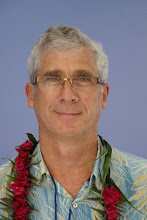
Last month, the abbot of the Benedictine Monastery in Hawaii, Fr. David, invited me to come and speak with the community and oblates. The oblates meet once a month for education and for training. I enjoy having the opportunity to speak with folks, and to share with them aspects of the Celtic tradition. This is an important story, and I am happy to share it. I weaved my presentation around the theme of "The Celtic Roots of Benedictine Spirituality". That subject allowed me to share some of the history and background of Celtic Christianity and to touch on many of the overlaps between both spiritual traditions. In one sense we're cousins, and Celtic spirituality played a role akin to John the Baptist, helping to prepare the way.
First of all, the monastery is located in the most perfect of settings; atop the mountains on the North Shore. One has to pass fields of sunflowers, and scores of peacocks and horses, before finally arriving at the monastery itself. Second, the community is so very welcoming and friendly. This is a perfect setting to have a retreat, or spiritual day away from one's usual daily chores. I met one woman who had been on retreat and you could tell that she loved the place, and was somewhat reluctant about returning home. If you could see the place, you would understand! If your in Hawaii, or even visiting, you should go.
I closed the presentation by citing some passages from Morris Berman's The Twilight of American Culture (2000), a stinging criticism of American pop culture. In this book, Berman finds the model of the Celtic Church, with its emphasis on learning and education, as a potential model to combat what he refers to as "McWorld", a mindless consumer driven world, that has no other goal in sight than consumption.
The quote is worth citing in full:
"The traditional view-which is at least partly correct-is that during the sixth and seventh centuries, when the lights were going out, monasteries, especially Irish ones, began to stow away the nuggets of intellectual achievement from Roman civilization, and to a lesser extent, Greece. By 700, writes the British historian Hugh Trevor-Roper, "European learning had fled to the bogs of Ireland". While Europe was sacked by Goths, Arabs, and Vikings, a few scholars such as the Venerable Bede (circa 673-735; lived at the Jarrow monastery in Northumbria) preserved a knowledge of the classics, carrying the seeds of Western life "through the grim winter of the Dark Ages". In the seventh century alone, two hundred monasteries were founded in Gaul". (pg. 77)
In other words, monasteries, monks, and oblates, hold a key to the future. They can help claim back a predominantly pagan culture by keeping the learning going, and in remaining true to our Western intellectual and cultural foundations. In this way, classical learning triumphs over political correctness, with the emphasis on the "new monastic" person, the "inner monk", which we all are called to develop. In so doing, each person will reject the false values of our time, and work to preserve the historical treasures of our Christian civilization. To quote David Knowles, that great historian of monasticism, the monasteries "became centres of light and life in a simple, static, semi-barbaric world, preserving and later diffusing what remained of ancient culture and spirituality". (pg 78)
There is hope for our time, and it lays nestled in churches and the monastery. What wonderful irony! A pearl laying there like a hidden treasure. There is a model that has worked in the past, in similiar times to our own. That model is none other than the Celtic monastery, and Celtic Christianity.
Many thanks to members of the Benedictine community and the oblates for their warm and hospitable welcome!
Showing posts with label civilization. Show all posts
Sunday, January 3, 2010
Sunday, November 22, 2009
Skellig Michael
"Looking back from the great civilizations of twelfth-century France or seventeenth-century Rome, it is hard to believe that for quite a long time-almost a hundred years-western Christianity survived by clinging to places like Skellig Michael, a pinnacle of rock eighteen miles from the Irish coast, rising seven hundred feet ot of the sea".
Sir Kenneth Clark's Civilization
I love this quote by Sir Kenneth Clark, and as I reead it, it makes me pause and think about how God often works in the most unusual and unpredictable ways. Think of it, as this is truly one of the great chapters in the history of the Christian faith. That Western Christianity could "hang in the balance" in such an obscure place as Skellig Michael, and later thrive in other parts of Europe, is well, truly amazing, and one of God's great gifts to mankind. Here is the sweet irony: there was more divine sweetness and light found in Skellig, than in any of the so called "great cities" of Europe including London, Rome, and Paris. To me, this is a great historical lesson that God often works outside our best efforts, and is often hidden. Still, the still small voice. And as with cities, probably so denominations and churches.
The Celts frequently referred to these sacred spots and events as "the place of one's resurrection", that is, the place where one struggled and worked out what God meant to be. It's understandable why the Celts would seek out such an isolated place like Skellig. No distractions, little else to focus on than one's faith. Leaving all the comforts of home behind. Kind of like a spiritual boot camp, though this time for life.
In a psychological sense, we can have our Skellig's anywhere. In our relationships, in the workplace, and even in our churches. And when it comes to that "inner work" many of us flee because we realize that like the steep slopes of Skellig, hard and focused labor is involved. Often, we run from the very tasks we need to do. So when we do, take heart, think back to Skellig Michael, and remember the lessons of that little community. Hard to imagine, that in the many of the so called civilized places in the Western world that both in piety and in scholarship, they were eclipsed by Skellig Michael.
One day, I plan to make another trip to Ireland. I was there once in 1977. I would want to visit Skellig Michael, make the rough sea journey, climb the rock steps, brace myself against the wind, listen to the churning sea below, look over to Little Skellig, and imagine what life was like there for the few who braved it. Even thousands of miles away, and centuries removed, their devotion makes me question some of my own understanding of Christianity.
In the meantime, I must admire from afar. I'm not sure how many of you are familiar with the Canadian singer, Loreena McKennitt. Her music is wonderful, a strange blend of Celtic and mystical themes, including "The Mystics Dream", "The Dark Night of the Soul", "All SoulsNight". She has a thoughtful song entitled Skellig Michael and the video captures both in words and pictures the terrible beauty of Skellig. I often listen to it, and it never fails to carry my imagination to a place far away.
Labels:
Celtic monks,
civilization,
Monastic option,
Skellig Michael
Saturday, October 3, 2009
How the Irish Saved Civilization
A natural starting point to begin learning about Celtic Christianity is Thomas Cahill’s How the Irish Saved Civilization (1995). Let's begin our discussion of the book, by citing two quotations:
"Without the mission of the Irish monks...the world that came after them would have been an entirely different one-a world without books".
"It is hard to believe" wrote Kenneth Clark, "that for quite a long time-almost a hundred years-western Christianity survived by clinging to places like Skellig Michael, a pinnacle of rock eighteen miles from the Irish coast, rising seven hundred feet out of the sea".
One of the great ironies of human history, is how a group of "uncivilized" monks, were able to keep the great literature of the world alive, revive Christianity, spread learning, and help awaken Europe from the Dark Ages. Seems to make no sense, so how could this happen? They were difficult times. The Roman Empire was in spiritual and moral decline. There was also the external pressure from thousands of invading Barbarians. These internal and external stressors ushered in a decline in social, moral, and civic responsibilities. A top heavy, and rigid bureaucracy sought survival instead of service. Even the military, once the pride of all Romans, was now despised. Sounds very familiar dosen't it?
As often with spiritual things, glimpses of light and change came where least expected-on the fringes. St. Patrick, the first missionary apostle, demonstrated that spirit, when he courageously went beyond the "safe" civilized Greco-Roman world to Ireland of all places. Talk about downward mobility! Patrick, however, knew what he was doing. As a pastor at heart, he cared for the spiritual and physical welfare of the land. But in addition to that, Patrick went the extra mile and learned the Irish language and culture so to speak in their language, and use their terms. No wonder Ireland loved Patrick so much. No doubt Partick was a courageous person too. He also spoke out against controversial subjects such as war, and may have been the first human being to speak out against slavery.
Patrick’s greatest gift was his personality and ability to assimilate new ideas. "Patrick found a way of swimming down to the depths of the Irish psyche and warming and transforming the Irish imagination-making it more humane and more noble while keeping it Irish". Patrick was a innovative person, not simply assimilating new ideas, but going in new directions with them. He was able to transform the pagan ideas of loyalty, courage, and generosity, into the Christian virtues of faith, hope, and love. Cahill writes, Patrick’s unique gift was his "Christianity-the first de-Romanized Christianity in human history, a Christianity without the sociopolitical baggage of the Greco-Roman world, a Christianity that completely inculturated itself in the Irish scene". This different way of viewing the faith and the world created a more open humanistic atmosphere. This opened the door to a more practical theology, things which actually worked for people. Patrick met people on their own terms, and in their own language and thought forms. The spirituality was simple, sensual, democratic, and one the population could easily relate to. The Irish experience had been filled with suffering and Patrick’s simple brand of spirituality was one they could understand.
Patrick, as many in Celtic lands would do, brought the spirituality of Egypt to Ireland. This created a different form of Christianity than the Roman kind. A monastic based Christianity fostered the development of monasteries, which became population centers, small city states, and hubs of learning. Abbots, and in some cases, abbesses, ruled instead of bishops. Learning and education were stressed and these institutions became the first real Universities, where all the world's books and ideas were discussed. It was something like a great books club where everyone was welcome to attend-even those who lived outside the cloister. It was a unique environment, culture and "experiment". Here, people learned to read the gospels, learn about the live of the saints, the mystics, the fathers of the Church, as well as Greek and Latin literature. Lets call it the original Open University.
This in itself, was a remarkable achievement, a beautiful model of what is possible with the church in the world. Learning and books again regained their rightful place in the life of the mind and culture. And though the life of the monk may have been somewhat "book centered", the scribes enjoyed their work and produced manuscripts of unsurpassed beauty such as The Book of Kells. The world Cahill describes, is one incredibly advanced in its views of religion, learning, education, the sexes, and of sexuality. It is a bold and welcome contrast to a Roman Christianity, which seemed to be headed in a different direction.
"Without the mission of the Irish monks...the world that came after them would have been an entirely different one-a world without books".
"It is hard to believe" wrote Kenneth Clark, "that for quite a long time-almost a hundred years-western Christianity survived by clinging to places like Skellig Michael, a pinnacle of rock eighteen miles from the Irish coast, rising seven hundred feet out of the sea".
One of the great ironies of human history, is how a group of "uncivilized" monks, were able to keep the great literature of the world alive, revive Christianity, spread learning, and help awaken Europe from the Dark Ages. Seems to make no sense, so how could this happen? They were difficult times. The Roman Empire was in spiritual and moral decline. There was also the external pressure from thousands of invading Barbarians. These internal and external stressors ushered in a decline in social, moral, and civic responsibilities. A top heavy, and rigid bureaucracy sought survival instead of service. Even the military, once the pride of all Romans, was now despised. Sounds very familiar dosen't it?
As often with spiritual things, glimpses of light and change came where least expected-on the fringes. St. Patrick, the first missionary apostle, demonstrated that spirit, when he courageously went beyond the "safe" civilized Greco-Roman world to Ireland of all places. Talk about downward mobility! Patrick, however, knew what he was doing. As a pastor at heart, he cared for the spiritual and physical welfare of the land. But in addition to that, Patrick went the extra mile and learned the Irish language and culture so to speak in their language, and use their terms. No wonder Ireland loved Patrick so much. No doubt Partick was a courageous person too. He also spoke out against controversial subjects such as war, and may have been the first human being to speak out against slavery.
Patrick’s greatest gift was his personality and ability to assimilate new ideas. "Patrick found a way of swimming down to the depths of the Irish psyche and warming and transforming the Irish imagination-making it more humane and more noble while keeping it Irish". Patrick was a innovative person, not simply assimilating new ideas, but going in new directions with them. He was able to transform the pagan ideas of loyalty, courage, and generosity, into the Christian virtues of faith, hope, and love. Cahill writes, Patrick’s unique gift was his "Christianity-the first de-Romanized Christianity in human history, a Christianity without the sociopolitical baggage of the Greco-Roman world, a Christianity that completely inculturated itself in the Irish scene". This different way of viewing the faith and the world created a more open humanistic atmosphere. This opened the door to a more practical theology, things which actually worked for people. Patrick met people on their own terms, and in their own language and thought forms. The spirituality was simple, sensual, democratic, and one the population could easily relate to. The Irish experience had been filled with suffering and Patrick’s simple brand of spirituality was one they could understand.
Patrick, as many in Celtic lands would do, brought the spirituality of Egypt to Ireland. This created a different form of Christianity than the Roman kind. A monastic based Christianity fostered the development of monasteries, which became population centers, small city states, and hubs of learning. Abbots, and in some cases, abbesses, ruled instead of bishops. Learning and education were stressed and these institutions became the first real Universities, where all the world's books and ideas were discussed. It was something like a great books club where everyone was welcome to attend-even those who lived outside the cloister. It was a unique environment, culture and "experiment". Here, people learned to read the gospels, learn about the live of the saints, the mystics, the fathers of the Church, as well as Greek and Latin literature. Lets call it the original Open University.
This in itself, was a remarkable achievement, a beautiful model of what is possible with the church in the world. Learning and books again regained their rightful place in the life of the mind and culture. And though the life of the monk may have been somewhat "book centered", the scribes enjoyed their work and produced manuscripts of unsurpassed beauty such as The Book of Kells. The world Cahill describes, is one incredibly advanced in its views of religion, learning, education, the sexes, and of sexuality. It is a bold and welcome contrast to a Roman Christianity, which seemed to be headed in a different direction.
Labels:
Celtic books,
Celtic monks,
civilization,
Irish
Subscribe to:
Posts (Atom)