Sunday, September 18, 2011
Homeless in Honolulu
This past Wednesday I was part of a panel that discussed the topic of homelessness in Honolulu. The event took place at St. Andrews Episcopal Cathedral and included Connie Mitchell from the Institute of Mental Health Homeless Shelter; Marc Alexander, the State's Homeless Coordinator, and Dorothy Hine from the Waikiki Health Center.
The event provided a wonderful opportunity to address the issues of homeless and some of the discusion looked at the role that the church should play with the homeless. The State of Hawaii has advocated that faith based groups ceased feeding the homeless in parks and instead center their volunteer efforts at shelters such as IHS and the Lighthouse. I commented that St. Aidan's ministry is somewhat different in that we have a service first, and that the feeding takes place on the grounds of St. Andrews. In addition, it was noted that a growing number of the folks who come to the 2pm feeding (typically around 200) can be described as the "hidden" homeless, that is, those who are on the verge of becoming homeless, and who typically live paycheck to paycheck. I also noted that with now one in six Americans in poverty, and one in five having some kind of mental illness, the church could/should play a significant role in helping people to find their way to healing and wholeness. The Celtic Church historically has always tried to welcome "the stranger" and those who are "searching". Many of us feel that we are providing a meaningful service to a disenfranchised group of people who for the most part are rejected by the cultural mainstream. Our Celtic tradition also reminds us that we find God in the face of the stranger, which is one of the reasons we believe in a ministry of hospitality.
There were approximately 70-75 people in attendance including some homeless people. In conclusion, I felt it was a wonderful forum, a wonderful start to a very difficult and complex social issue. I hope that we could have continued discussions on this topic.
Thursday, September 15, 2011
Gaelic Blessing by John Rutter
Been listening to some of John Rutter's music of late. I've identified a few of Rutter's pieces I like best, and one is "Gaelic Blessing" or "Deep Peace".
Here are the words:
Deep peace of the running wave to you
Deep peace of the flowing air to you
Deep peace of the quiet earth to you
Deep peace of the shining stars to you
Deep peace of the gentle night to you
Moon and stars pour their healing light on you
Deep peace of Christ, of Christ
The light to the world to you
Deep peace of Christ to you
And now listen to the music by the Cambridge singers.
Great stuff to start and end the day.
The link is here.
Here are the words:
Deep peace of the running wave to you
Deep peace of the flowing air to you
Deep peace of the quiet earth to you
Deep peace of the shining stars to you
Deep peace of the gentle night to you
Moon and stars pour their healing light on you
Deep peace of Christ, of Christ
The light to the world to you
Deep peace of Christ to you
And now listen to the music by the Cambridge singers.
Great stuff to start and end the day.
The link is here.
Sunday, September 11, 2011
Homelessness in Hawaii
I had the chance a few weeks back to meet with Secretary Donovan (from HUD), who is on the President's Cabinet; Hawaii's two senators; Senators Akaka and Inouye; Governor Neil Abercrombie, and Mayor Carlise of Honolulu, to discuss homeless veterans. I've included a picture of myself with Senator Akaka and Secretary Donovon.
It's fantastic that folks at such high levels of the government are so deeply committed to the issues of homeless veterans. In addition, I was very impressed just how knowledgable and concerned they were with the veterans and curious to know what specific actions are being undertaken to help get veterans off the street. Makes me proud to be an American.
Saturday, July 30, 2011
St. Romuald's Brief Rule
Sit in your cell as in paradise;
put the whole world behind you and forget it;
like a skilled angler on the lookout for a catch
keep a careful eye on your thoughts.
The path you follow is in the psalms-dont' leave it.
If you've come with a novice's enthusiasm and can't
accomplish what you want, take every chance you can find
to sing the psalms in your heart and to understand them
with your head; if you mind wanders as you read
don't give up but hurry back and try again.
Above all realize that you are in God's presence;
hold your heart there in wonder as if before your sovereign.
Empty yourself completely;
sit waiting, content with God's gift,
like a little chick tasting and eating nothing
but what its mother brings.
Wednesday, July 27, 2011
Incarnation Monastery, Berkeley
"The deeper the contemplative communion, the wider the embrace in solidarity. Solitude teaches us, after all, that we are really brothers and sisters of the same family. This is the great gift that the "monk within" offers the world-human solidarity, universally expressed in communion with God. And a great irony rest within this gift. Authentically lived, monastic solitude breaks through human barriers of isolation and speak a silent word of universal love and solidarity with all life".
The Language of Silence (2003) Peter-Damian Belisle
On this blog you have heard me mention the importance of having regular "retreats" or "quiet times" where one can reflect on their own spiritual journey. Taking "time outs" like these are wise things to do. Last week, I had the opportunity to stay at Incarnation Monastery (IM) in Berkeley, California. The monastery-actually a retreat house-is located up a long steep road, some twenty five minutes by foot from downtown Berkeley. Far from the madding hustle and bustle of the famous University and city.
My visit to IM was not what I expected it to be which in fact was a good thing. Life is never what we think, is it? IM is a Benedictine monastery, however a branch of the Benedictine tradition called the Camaldolese who emphasize contemplation, silence and solitude. The Camaldolese are in fact a fascinating offshoot of the Benedictines, who have an interesting story. The founder, St. Romulad (1027) sought to develop a stricter brand of the Benedictine order, one which was more hermitic instead of cenobitic (or communal). A unique feature of a Camaldolese monastery is the emphasis on quiet-a challange for most of us noisy people who live our lives in the busy world. I must confess the stress on "silence" takes some getting used to and is a challenge for those of us who co-exist with iPADS, cell phones and blogs! Yet as the minutes, hours and days progressed, the silence begins to perform its wonderful work. For example, I began questioning whether I needed these technical toys. I was starting to enjoy the solitude and time to read "In Praise of Hiddenness", a study on soltiude. On the downside, efforts to communicate verbally seemed awkward and clumsy.
One of the gems of the monastery is Fr. Thomas Matus, a Camaldolese monk who has written several books about Bede Griffiths, and who also had the opportunity to worked in India at Shantivanam. Mathus's "Bede Griffiths Essential Writings" is an excellent and challanging book which is an anthology of one of the most remarkable Christian figures of the last century. I enjoyed this encounter and am looking forward to reading some of Fr. Mathus's other books and useful clips on YouTube.
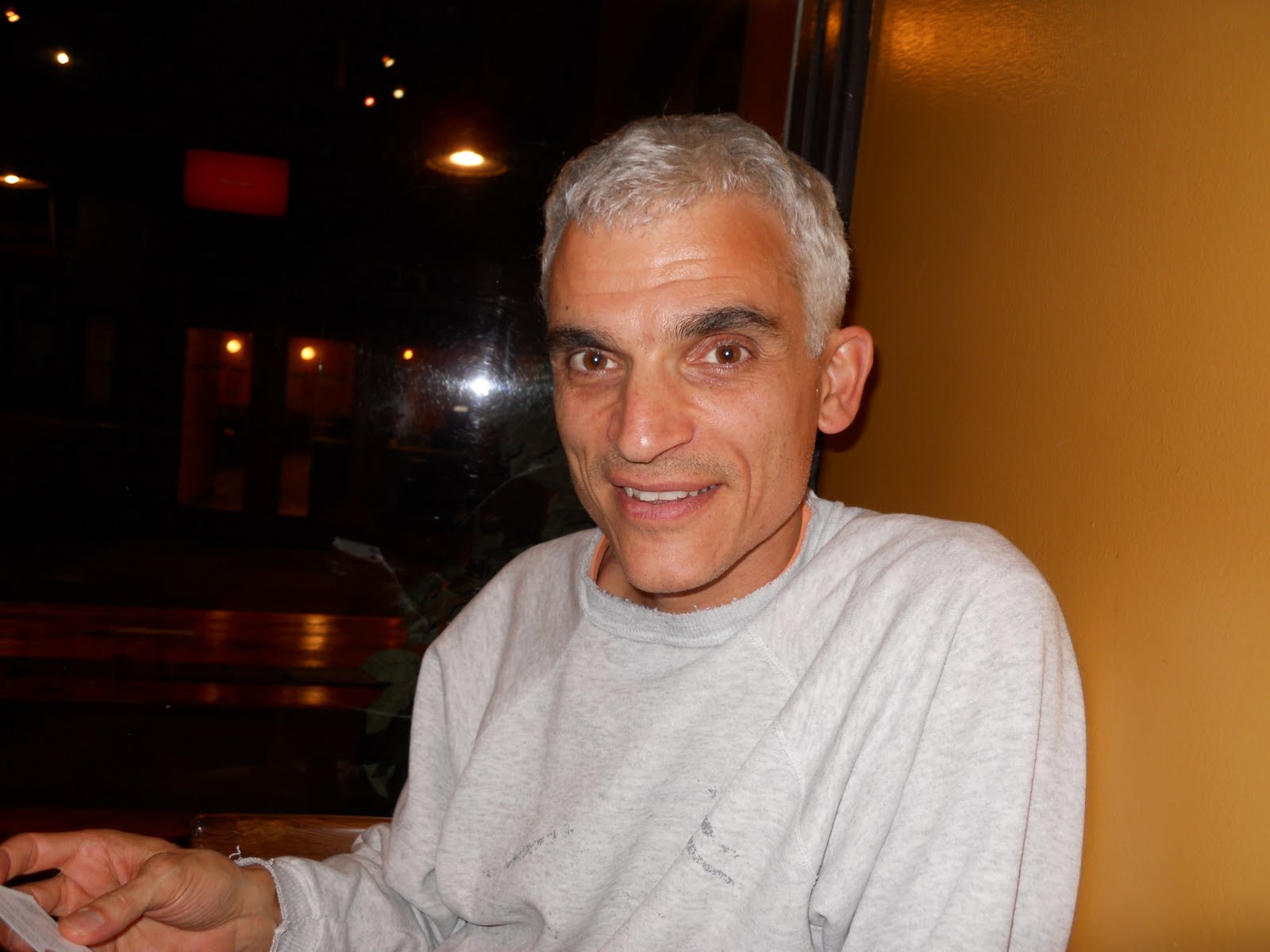
Monasteries are also wonderful places to meet other people. I want to take a shout out to Leonard Capozzi who I met at the monastery. Leonard is a great person, deeply spiritual and insightful. I enjoyed having the chance to speak with Lenny about his spiritual experience and admire his desire to live to live an authentic, meaningful Christian life, and to live according to the Benedictine Rule. Thanks for your kindness! I've included a photo of Leonard above.
So in all, going to IM was useful for several reasons. One, helping me to stay within the riches of the Benedictine tradition with the emphasis on silence, discipline, and focus. And second, to have the opportunity to meet such interesting and lovely people as Fr. Mathus and Lenny Capozzi.
Tuesday, July 12, 2011
Hildegard von Bingen: A Woman of Vision
Vision is a wonderful film about the life of the 12th century Benedictine nun, Hildegard von Bingen. von Bingen was a woman well ahead of her time, a maveric in every positive sense of that word. She was multi-talented; a Christian mystic, writer, composer, naturalist, herbalist and ecological activist.
Each time I hear that name, "Hildegard von Bingen", I am reminded that I first learned about this unique woman in a monastic setting, at the Order of the Holy Cross, West Park, New York. How fitting was that and yet how appropriate! A personal reminder of the great religious and spiritual writers who have come from monastic settings. This German film does a fantastic job in introducing one of the fascinating religious mystics of her time and ours.
Born almost a thousand years ago (that's right a thousand years), von Bingen remains a person who seems well ahead of her time. Surprisingly von Bingen's life, themes, and interests seem strangely modern and resonate to us moderns. The film demonstrates how with courage von Bingen was able to challenge church rules and found several convents. She was also a theologian who loved books and learning. Some of the titles of von Bingen's books are "Know the Paths of the Lord", "The Healing Power of Nature", and "The Book of Divine Works". von Bingen was also a scientist and herbalist. She was also a composer and her music is wonderful and hanuting-again ahead of her time. And just as the title Vision indicates, von Bingen also had "visions" of God and the future.
Vision is an important film for several reasons. Here you will be introduced to a unique and passionate Christian mystic. Second, you will have the opportunity to learn about a fascinating and profound woman who seemed well ahead of her time and even ours. Third, you will be introduced to von Bingen's main ideas and some of her music. Fourth, you will have the chance to learn something about the Benedictine way and tradition. Fifth, you will understand that von Bingen also is within the Celtic tradition. von Bingen warned that we needed to protect Nature and that if we mistreated "the elements", it could turn against us.
I've included a link here where you can see clips from the movie and listen to some of von Bingen's music.
Sunday, July 3, 2011
Celtic Fire
"In every church and monastery of Celtic Britain and Ireland a fire was kept burning, day and night, summer and winter, as a sign of God's presence...While the rest of Europe was entering a dark age of conflict and division, after the fall of the Roman Empire, the Christian gospel was lighting the hearts of the rugged Celtic tribesman, and thousands upon thousands of simple men and women became monks and missionaries, poets and pilgrims, ablaze with the love of Christ" (1-2).
Celtic Fire is a wonderful book, and a fine introduction to Celtic Christianity. The book contains a selection of writings from ancient Britain and Ireland and is skillfully presented by the Revd. Robert Van De Weyer, an Anglican priest who has written often on Celtic themes.
Celtic Fire begins with a sparkling 25 page essay providing readers with an overview of some of the uniqueness features of Celtic Christianity including the Druids, Desert Fathers, and the theology of Pelagius. The bulk of the book contains an anthology which highlights many of the famous people and literature in Celtic Christianity. For example, there are hagiographical sections which include the Confession of Patrick, the voyage of St. Brendan, Aidan, Hilda, and others. The "highlites" of their lives are presented and are well worth reading.
Another section contains some the better known prayers generated the Celtic saints. It's evening now as I write and let me recite a prayer entitled "Covering the Fire":
Lord, preserve the fire, as Christ preseves us all. Lord, may its warmth reamin in our midst, as Christ is always among us. Lord, may it rise to life in the morning, as we shall rise with Christ to eternal life." (147).
I love these kind of prayers and it reminds of just how tied to Nature and the Seasons of Life the Celts were. We moderns seem to have lost these kinds of attachments.
One of the most interesting sections in Celtic Fire is the latter part of the book which shares some unique Celtic literary devices. A popular Welsh literary form was the "gnome" a maxim which was preceded by an unrelated image. Reading them, I am reminded of Zen "koans". Let me share a few:
"Red is the cock's comb, and loud his voice. God praises man when man praises God".
"Delightful are the tops of gorse bushes, their blossom reflects the brightness of the sun. None can know the truth except God".
The Irish also had some unique literary devices. A "triad", or mnemonic, was used to express moral and spiritual truths. I find these to be very clever and witty and its easy to picture monks dreaming up these pithy sayings.
"Three sources of new life: a woman's belly, a hen's egg, a wrong forgiven".
"Three people whose ears are closed: a king bent on conquest, a merchent bent on profit, a monk who thinks himself holy".
"Three things that unlock the secrets of the soul: heavy drinking, violent anger, innocent trust".
I hope this wets your appetite for more. Celtic Fire reminds us that the divine spirit is living everywhere, and in every living creature, and in the world around us. And like olden times, the lives of the Celtic saints can be a light of brightness for us again.
Subscribe to:
Posts (Atom)